
About Unit 3
💭 Essential Question: How do population and development affect communities?
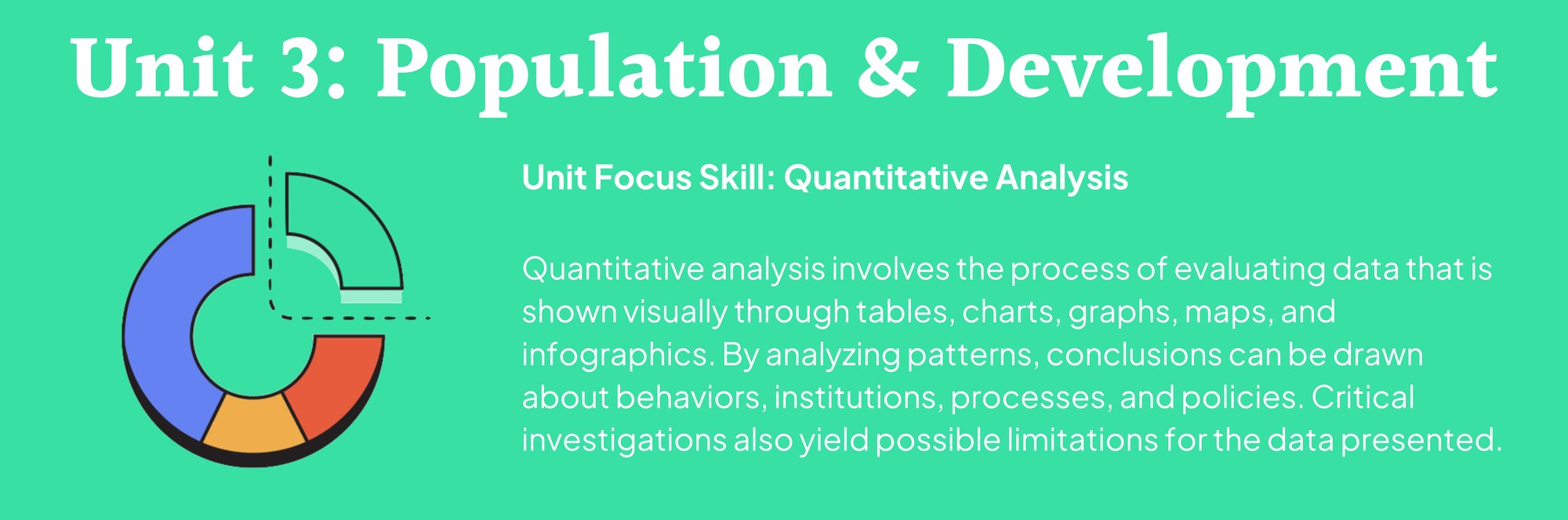
Unit 3: Population and Development focuses on how population patterns influence communities, development, and quality of life. Students explore why people live where they do, how populations grow and change, and how demographic data can help us better understand communities. They examine population growth and distribution, analyze development and quality-of-life indicators, and investigate challenges related to land use, resources, and environmental change. Throughout the unit, students develop the disciplinary skill of quantitative analysis, using maps, charts, graphs, and other data sources to identify patterns, draw conclusions, and evaluate evidence.
Although the standards are organized by region, this course takes a thematic approach. Each unit integrates multiple regions, allowing driving concepts to be revisited throughout. In this unit, students examine examples from Africa, Asia, Latin America and the Caribbean, Europe, and North America. Many of the concepts introduced in this unit will be revisited and expanded in later units on migration, urbanization, and environmental geography.

%20(800%20x%20200%20px)-Jun-16-2025-03-52-14-7219-PM.png "Website button (600 x 200 px) (800 x 200 px)-Jun-16-2025-03-52-14-7219-PM")
Formatives assessments are a powerful way to measure how your students are progressing towards learning objectives (Additional Video).
▶️ Video
%20(800%20x%20200%20px)-Jul-25-2025-10-05-34-0370-PM.png "Website button (600 x 200 px) (800 x 200 px)-Jul-25-2025-10-05-34-0370-PM")